
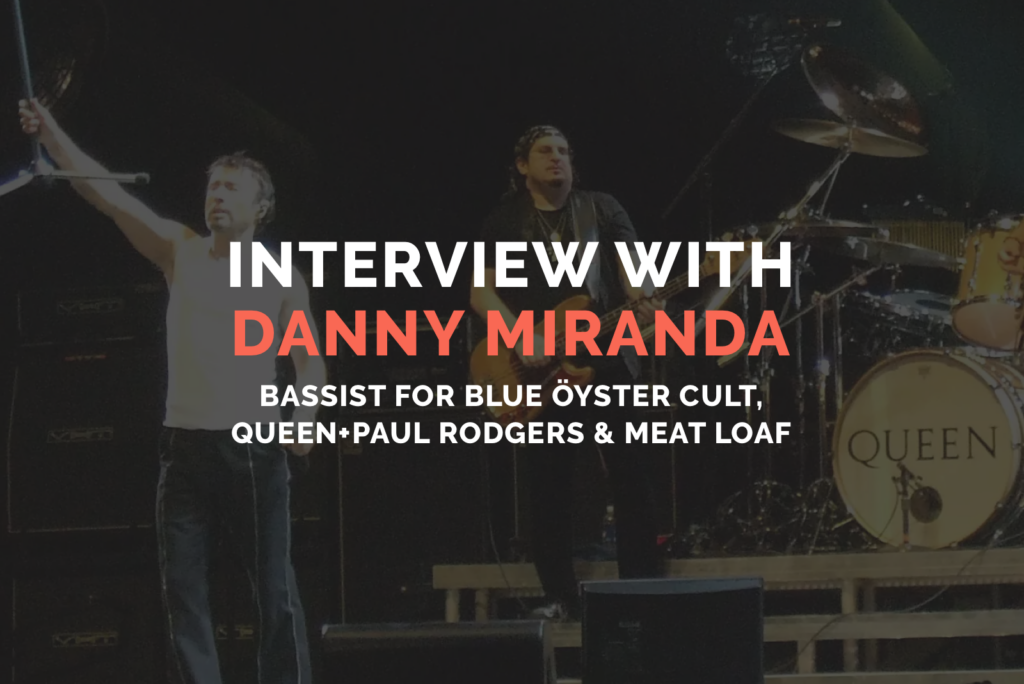
nterview with Danny Miranda, BASSIST WITH – BLUE ÖYSTER CULT – QUEEN+PAUL RODGERS – Meatlof
Few bass players have a résumé quite like Danny Miranda’s. From touring and recording with Queen+Paul Rodgers and Meat Loaf to years behind the bass with Blue Öyster Cult, Danny has spent his career playing alongside some of rock’s most iconic musicians. Now, through AirGigs, independent artists can bring that same experience and musical instinct to their own recordings. We caught up with Danny to talk about where his approach to bass comes from, what decades on world-class stages have taught him, and why the best bass part is often less about showing off than making the entire song better.
You’ve had an incredible career playing with Blue Öyster Cult, Queen+Paul Rodgers, Meat Loaf and many others. How did bass first enter your life, and what were some of the key moments that led to where you are today?
Contact Danny Miranda to discuss your project.
Bass first entered my life through my brother. My brother is a keyboard player, and one of his specialties is Chicago blues B3 organ. As you know, with Jimmy Smith and others, it usually doesn’t contain an electric bass player. It’s either the organist’s left hand or his feet.
My brother almost never played with a bass player in bands. He was the bass player!
He also played organ in church, so hearing the bass pedals and hearing these amazing classical pieces come to life, where you can hear the movement in the bass, really had a big impact on me. Him playing everything from Top 40 to rock to jazz, and playing real bass parts with his left hand or his feet, was my first experience watching bass parts being formed and improvised.
After I started taking bass seriously, I started paying attention to the bass players in the bands I was listening to – Motown, Philly soul, The Beatles, The Wrecking Crew, and then a lot of English rock and English blues-based music.
Dee Murray, John Deacon, Kenny Aaronson, Geddy Lee, Jack Bruce, etc. That was the beginning of the rabbit hole that continues to this day!
What was it like stepping into the world of Queen+Paul Rodgers? Was there a particular moment when the magnitude of that experience really hit you?
It was a very surreal experience. I had gotten a warm-up to it because I joined the theatrical play We Will Rock You, which was the music of Queen, a few months before I started touring with the band.
Therefore, I was living the music 24 hours a day, but it was different playing with the actual band.
When we actually started playing shows, the magnitude of the energy was so overwhelming it was hard to keep my feet on the ground!
You’ve spent years playing with Blue Öyster Cult. What has that experience taught you about being a great bass player beyond simply playing the right notes?
The great thing about when I joined Blue Öyster Cult was that we were doing a lot of shows that had multiple bands on the itinerary, so I got to see a lot of seasoned bands do their thing. Being new to the game, I tried to pick up and learn everything that I saw being done right, and everything that was being done wrong.
It’s about what not to play as much as it is about what to play.
And it depends on what kind of freedom you may or may not get in whatever band you play for. I was fortunate enough with BOC that they gave me a lot of freedom. As long as I treated the legacy of the music with respect, I had a lot of room to put my own personality into things.
When you hear a song for the first time, what are you listening for before you ever pick up the bass?
I think of what is missing and what could make the song better. I think of what could raise the whole tune to a different plane.
My favorite bass players always made their parts a part of the song – part of the bloodstream that runs through the body of a song.
So instead of thinking, “What can I do that’s interesting and that will impress other bass players or other musicians?” I think, “What can make everybody else sound better?”
Bass can completely change the feel of a track without the listener necessarily realizing why. What are some of the decisions a great bassist makes that can elevate a song?
Everything from tone, touch, volume, sound, and the instrument itself.
One of the things I love about people like Tony Levin or Geddy Lee is that the word “bass” doesn’t have to mean bass guitar!
It could mean synth bass. It could mean Taurus pedals. It could mean Chapman Stick, etc.
The low end is a very complicated and beautiful part of real estate in the music world. The shapes and tonalities that can be created are endless!
Contact Danny Miranda to discuss your project.
You work across rock, metal, Americana, folk, R&B, country and other styles. How do you adapt your approach to the song while still bringing your own musical personality to it?
That’s an interesting question because sometimes I like to stay true to the genre, and other times I like to mix it up and throw other things in – like putting a rock ’n’ roll bass line into a new age piece.
Sometimes it’s good to think like a producer instead of just a bass player, because a producer isn’t biased toward an instrument. He or she might say, “Let’s throw a French horn in here. Let’s throw a crazy vocal effect in here,” etc.
So as a bass player, it’s good to think outside the box and sometimes get out of traditions.
And then again, there are other times where authenticity rules and you want a track to sound as pure as possible.
Several of your AirGigs clients have commented on how quickly you seem to understand what their song needs. How do you get inside an artist’s vision when you’re working remotely and may never have met them?
Well, that’s easier than one would think. I start off a conversation. I try and ask him or her some questions about where they’re from, how old they are, etc. Are they in a band? Are they a solo artist? Anything that can have an impact on their creation.
They usually open up and tell me a bit about themselves because it’s their music and it’s their art, so they want me to have an understanding about where they’re coming from.
I don’t want to take them away from their initial vision, and I just try and do my best to give the song what I feel it could use and what will enhance what is already there.
I usually get good direction, with the artist telling me what they’re looking for.
It’s a great feeling knowing that you have pleased the artist and that they appreciate what you’ve done to their music!
One client described your playing as having “just the right amount of flair.” How do you find the balance between adding something special and knowing when to keep things simple?
That’s an interesting balance. It’s always good to put a little bit of flair and a little spice into it if you feel the need, but it’s also nice to “leave it alone“ and let all of parts flourish and gel together.
Making an instrument stand out just enough, but not too much to take attention away from the melody is important to me.
I love to plan things out. I love having a game plan, but I also like to be spontaneous and just be reactionary and that’s where the flare can come into play and you never know what kind of surprises wind up on a track!
Quite often I provide my clients with several options as part of the finished product. They can then choose and mix my performances to their liking.
You’ve played thousands of hours with world-class musicians on stages and in studios. How does that experience show up when you’re recording a bass track for an independent artist?
Contact Danny Miranda to discuss your project.
Ive been influenced in so many ways and I’ve learned so much from the people I’ve played with, where it’s permanently etched in my memory. I naturally channel all of that into who I am working for at that particular moment. It’s also the sound. I like to take a step back and listen to what bass would be best suited for this particular song. Choosing the right bass is equally as important as choosing what to play.
What information is most helpful for a songwriter to give you before you start a session? Do you prefer detailed direction, reference tracks, or some freedom to interpret the song yourself?
I would like them to paint a picture of what they’re seeing or hearing – what they were thinking of while they were writing it, what they wanted it to feel and sound like at the end, what they were thinking about, what they were going through, etc.
All of that helps because it’s not just the notes. In fact, I feel the older I get, the notes are by far not the most important part of what to play. It’s the feeling that you want to give off in the overall picture.
What separates the musicians who are great players from the musicians artists want to hire again and again?
The ones who listen. Listening to the music, listening to the artist, listening to the producer, listening to what they want, trying to think ahead and read their minds – which is not always the easiest thing to do.
You have to please them. You have to make them feel that their music wouldn’t be as good without your presence there.
That is never easy, but when it’s achieved, it’s very gratifying.
When an artist hires Danny Miranda today, what do you hope they feel when they hear your bass track come back for the first time?
I hope they feel that I made their song sound better – the instruments, the music, the melody – that I helped it along, that I lifted it up to another level, and did something that is unique to me that not just anybody else could do.
Would you like to share your thoughts?
Your email address will not be published. Required fields are marked *